TIP: The Elements of a Competency Model
Though the elements of a model vary, there are usually three main components.

- A title and definition. A title might consist of “Being a team player.” The definition should describe what a team player should be. Descriptions could include “Treating others with courtesy, Working to resolve conflicts, etc.”
- Descriptions of activities or behaviors. Link the description to the competency. In this case, what are the activities and behaviors of a team player? The list might include “Capitalizing on strengths of others, Motivating others to contribute, etc.”
- A diagram of the model. A diagram helps everyone visualize the competency and grasp the model. You can see various models diagrammed on this page.
For more information on Competency Modeling and Training, contact LMJ&A at leah@lmja.com. We can help your organization successfully employ competency modeling in the workplace. Working with you step-by-step, we will support and guide your organization through each component of the process. Give us a call at 301-670-0051.
Stealth Startup
 It’s a very intriguing name for Obama’s quest to recruit top talent from the likes of Google and Facebook. While this article in Fast Company is long, it’s a very interesting one, focusing on the mission of these top recruits – to “reboot” how government works.
Most of these recruits are young professionals that were on successful career tracks with public companies. What made them take a salary cut, move from one coast to another and work for the government is brilliantly explained in this article. Without a doubt, the transfixing power of creating technology that will make life easier for millions of people, had a lot to do with the decision to take a technology job in Obama’s administration. The article explains what inspires these young men and women and helps us more fully understand their work ethics.
We highly recommend that you put some time aside at lunch, or at the end of the day to read the entire article, but here are some of the high points.
- Healthcare.gov – remember when the site just didn’t work? People were getting locked up and the site froze from too many visitors. It wasn’t the result of a dearth of engineering talent in the DC area, but rather the technique they used to build the site. Instead of one huge project, the fix-it team rolled out the site in stages – testing it, improving it and repeating the process to get the right outcome. It’s a strategy used by most public companies in order to build software that works. It’s called building “agile” software.
- Making Government Work Better – The young people recruited for these government projects aren’t just software engineers, but according to the article, “they’re data scientist, user-experience gurus, product managers and design savants.” Making the user experience better on any platform is what they strive for. “Fixing bugs” for software companies is not very inspirational. But solving problems that have plagued the government for years is both satisfying and intriguing. These young professionals are uniquely capable of handling these “planet-sized” websites, since they’ve worked on huge sites solving various problems while creating extraordinary growth for their former companies.
- Changing Minds About the Slowness of Government – According to this group of talented professionals, “Everything else is getting done faster.” The technology industry is built on the belief that processes can become twice as efficient every two years. Because that belief is so integral to their work, these professionals have a hunger for increased performance. If what we do online every day is completed far faster than before, then the same should be true for the Federal government.
- Washington, the “Go-To” Place for Technology Gurus – The folks now being lured to DC are arguably among the very best. Talent is extremely important, but so is attitude, patience, collaboration and the ability to work within the structure of the government. According to the article, candidates are screened for EQ – that is, emotional intelligence. The workload within the Federal Government is huge. Can this team create enough momentum, before Obama’s second term ends, to achieve a stable environment and re-energize government agencies?
These technology gurus believe they’ve already had an impact. They can gauge improvement on various sites – from the Immigration site to the Veterans website. Interestingly enough, the recruitment team is not expecting these young professionals to make a career out of the Federal Government. But rather to enlist them for a year or two to accomplish real change. As a result, there is now a third option open to technology gurus – a start-up, a big company and now, Washington.
Tip: Making Incremental Changes
 The healthcare.gov site successfully deployed by making incremental changes, testing the changes and making improvements. Can this process of incremental change work at your organization? Here are some thoughts that might lead to success.
- Making incremental changes is not as disruptive and typically does not significantly threaten existing structures.
- Incremental changes are typically slower, but can move a team steadily forward. Incremental gains prove better than none at all.
- Often, the magnitude of a change will dictate how employees react. Employees will often react positively to a change that does not cause them to move too far from what they know.
- Incremental change is often determined by the gap between the current state and where you want to end up. If the gap is large, incremental changes may not be possible. But incremental changes require less change management – you’re asking your employees to make a smaller leap from what they know, to what they are comfortable with.
Change and change management can be taught. LMJA works with organizational challenges. If you need help or would like to discuss your options, give us a call at 301-670-0051, or email me at Leadership@lmja.com.
Shrinking Space
 The OMB, Office of Management and Budget, is putting federal office space and excess property into a deeper freeze. Announced Wednesday, April 1, OMB is requiring civilian agencies and the Defense Department to create a plan for reducing their footprint over the next 5 years. David Mader, the OMB controller announced two mandates: Set a target for reduction in square footage and adopt space design standards for any future development.
One Tactic. Reducing the total real property footprint will most likely result in more expanded teleworking for agencies and the DOD. If agencies cannot lease or buy new space, they must consolidate. The reduction plan has already had positive results since it was announced in 2013. This five year plan will likely shrink the overall footprint even more.
Successful Teleworking. So how do agencies heed this call for a smaller footprint? Achieving a successful telework program will certainly help. And according to the Report to the Congress on the 2013 Status of Telework in the Federal Government, most successful telework programs have been achieved through organizational change. When agencies actively work toward change management, goal setting becomes an essential practice. Goals that are SMART, that is, Specific, Measurable, Achievable, Relevant and Time-bound, help provide the motivation to facilitate progress. So an agency that is serious about promoting a change in work toward teleworking can gauge its success and effectiveness of the program by setting SMART goals.
Measuring Success. What goals can your agency use to measure its success? Here are some examples.
- Increase the eligibility for telework positions
- Set a number (percentage) of the employees that you expect to telework consistently in the coming year
- Set a number (percentage) of the employees that you expect to telework during certain situations in the coming year
- Develop and monitor a survey quarterly to measure the effectiveness of teleworking
- Measure the cost savings of telework
- Add a telework performance goal to employee reviews
- Identify Best Practices of telework employees and publish
Proof of Success. Over the next five years, as OMB requires agencies to reduce their footprint. Assessing your goals and results will be key. Developing clear goals, and meeting them, is possible with the right focus.
Need Help? Leah M. Joppy & Associates can help your agency identify needs and solutions. Then we’ll put together the right program for you – and get results! Give us a call at (301) 670-0051 to discuss an approach that will work for your agency.
Telework – What Happens?
 What happens when employees telework? Since telework has become an important organizational change, not only in the Federal Government but also in the private sector, it’s important for all organizations to envision the success of the effort and measure the results. In a recent report, “Status of Telework in the Federal Government – Report to Congress,” the US office of Personnel Management noted an improvement in employee attitude as a result of telework capabilities.
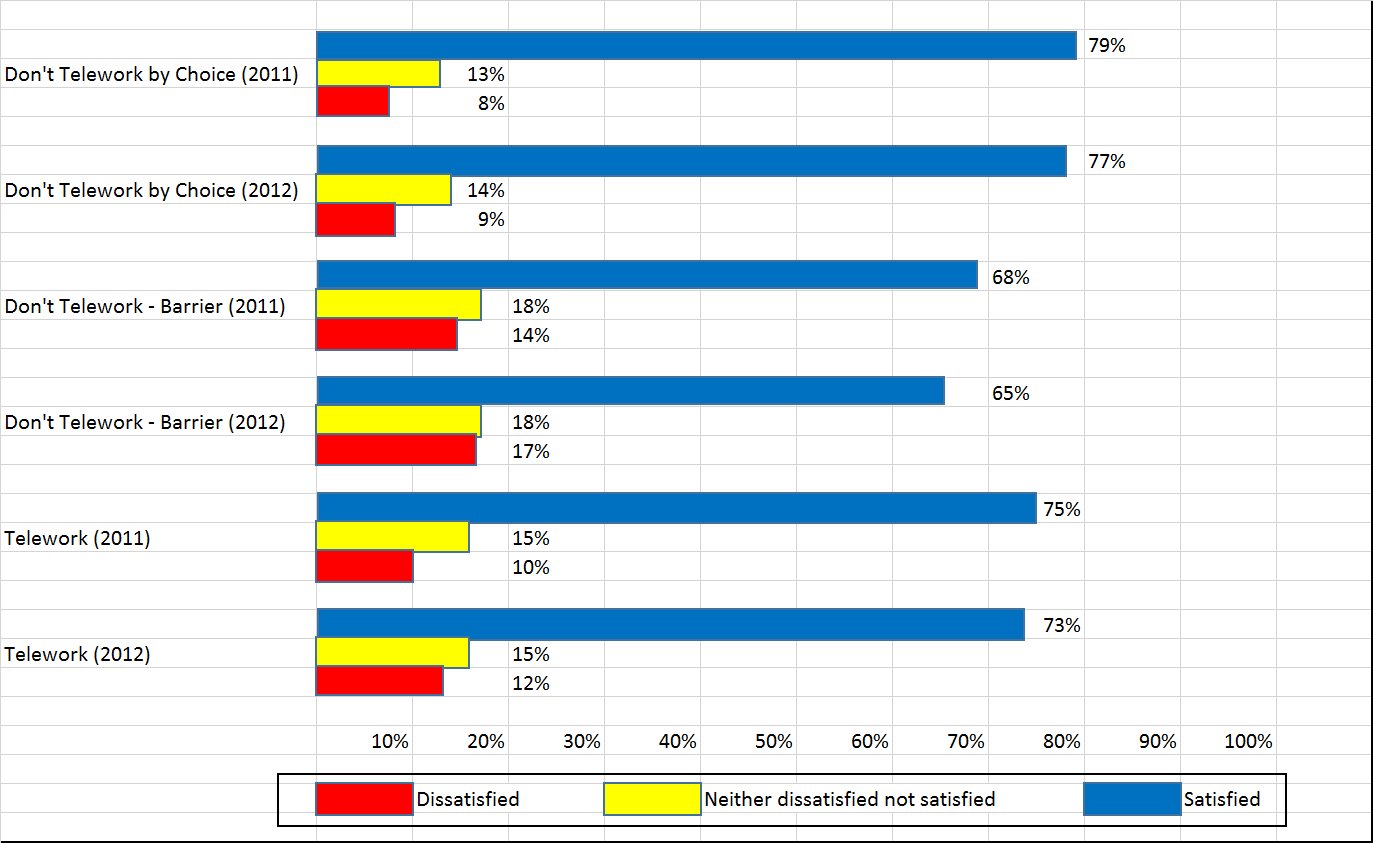
Measuring the Improvement in Employee Attitude. The Federal Employment Viewpoint Survey (FEVS) shows the potential for telework to influence important employee attitudinal and perceptual variables. The survey looked at employees who telework, those who don’t because of a barrier of some sort, and those who do not telework by choice. Demonstrated in the report is the value of autonomy – “I get to make the decision, to telework or not.” When employees have a choice, job satisfaction increases. Those employees who face barriers to telework reported lower job satisfaction scores. Typically, their attitudes toward the organization and their supervisors are less positive.
Academic research indicates that telework program participants are more likely to exhibit job satisfaction and improved performance. The FEVS survey noted similar findings. There was a larger percentage of teleworkers who reported satisfaction with their jobs than those who were not able to telework. In 2011, those figures were 75% vs 68%, and in 2012 the figures were 73% vs 65%. The survey seems to suggest that existence of telework policies benefits the entire workforce in indirect but positive ways.
In the 2012 FEVS survey, 68% of the respondents reported satisfaction with their jobs. And 15% reported dissatisfaction. The results also show that there is a decline in the percentage of job satisfied employees between 2012 (68% ) and 2011 (71%). This general decline is also reflected in a comparison of teleworker job satisfaction data – reporting 68% job satisfaction in 2011 and 65% in 2012.
Please click on the chart below for more information on job satisfaction.
Tip: Managing Teams
Last month we provided a few tips on successful teleworking. Here are some key tips on Managing Teams.
- Train your team. While you may feel that your employees should know their job, training your employees for working on a team will help build successful teams.
- Keep your team focused. Putting a team together, and then not following up on their progress is asking for trouble. Instead, install a project management system or some type of follow-up plan that allows you to keep the team focused and on task. Your time will be well-spent; your team will be successful.
- Create a timeline. What is your vision? Working with the team, create quarterly touch points. Breaking a project down by quarters makes it easier to reach intermittent goals – assuring success for the overall project.
If you would like more information on Development issues, including Teamwork and Management, please give LMJA Associates a call at 301-670-0051 or email us at Leah@LMJA.com.
Can Strategic Planning Make Your Job Easier?
 Mention Strategic Planning in a meeting and you’re liable to hear lots of groans! For many companies and organizations, strategic planning involves weeks of research, competitive analysis, meetings, budgeting and planning. Besides all that work, strategic planning conjures up the idea that we have to KNOW the future. Or at least take a good guess. Good luck with that. Besides the fear of making the wrong decision, thinking too far in the future just isn’t practical anymore. Thanks to technology and the world we live in, most businesses see so much change that they are revising their strategic plans every 18 months. So, what if you just plan for the year? Make it simple. Here’s how.
First, Analyze. What has worked in the past? What has not worked? Are your employees fully trained? What areas of expertise are lacking? Decide what your strategy is for the year.
Focus on the issues at hand. What are the initiatives in your area that will have the most impact on the organization as a whole? These are the ones you want to focus on. Do your employees have the expertise to carry out the initiatives as planned? Can your area be more productive given more expertise?
Start with the end in mind. Where do you want to be by December 2015? If you know what progress needs to be made, it’s easier to schedule check points throughout the year.
Make a check list. Assuming there are goals for the department and the individual employees, make a list of what needs to be accomplished. Incorporate change management and leadership development training to transform your area to a higher performing organization.
Schedule it. Work it out on paper. What is the initiative? What results are you expecting? And what tools are needed to get there? When you break it down bit by bit, you’ll recognize whether or not your plan is feasible.
Review performance. Meet quarterly, or more often if necessary, to make sure the initiative hasn’t hit a roadblock. Don’t assume that you’ll know when that happens. Too often, organizations learn in September or October that the initiative they thought was humming along, hit a roadblock in June. Now, months have gone by without progress.
Keep it simple. You can tackle a lot, and be disappointed in your results. Or you can take the top issues and get results. Your goal is to get results, so that the next year, you can focus on other issues.
Need some help with starting or updating a strategic plan? Leadership development? Dealing with communication and conflict within teams? We can help. Give Leah M. Joppy & Associates a call at 301-670-0051 or email us at leah@lmja.com – we’d love to help.
Try our tip. Read on for an easy tip to keep you focused on your strategy and get results!
Tip: Divide By Twelve!
 Looking at the entire year and what you hope to accomplish can sometimes be daunting. But what if you broke it down into twelve months? You can stay on track easier, you can see quickly when you are behind schedule, and you can correct problems by adding the right tools to keep you on target. Here’s an example:
- Create a spreadsheet with twelve columns. Each column is labeled with a month of the year. We highly recommend using a Work Plan White Board, ‘strategically’ placed in an area within your office so everyone can see their individual progress and how it is aligning with their colleagues progress. Having this information readily available for all to see will head off any potential problems and minimize obstacles.
- The first worksheet is given the name of the first initiative.
- Then think of the year in terms of the initiative. You know where you want to be by December, so break it down. What are the steps you need to take to get to the end result? Schedule these for the appropriate months. You can even list the person who has responsibility for each phase of the initiative.
- Remember to add in reinforcement or follow up – check points on the calendar keep initiatives from slipping. What are the expected results you will see during the year?
Tackling each initiative this way makes it easier to accomplish your plan. You can assign responsibilities. Add reinforcement when necessary. And schedule additional training as needed. Along the way, everyone has a feeling of accomplishment as tasks are finalized and progress is visible.