What Are the Barriers to Self-Assessment?
 As noted in our previous article on Self-Awareness In Career Development, building self-awareness involves collecting data on your values, skills, talents and other personal qualities. Because environments are continually changing and issues may be complex, self-assessments may be inaccurate if certain problems exist. Here are some categories of problems that should be considered in every self-assessment.
- Too Much, or Too Little Data. Too much or too little information leads to a distorted self-awareness. This is especially true when data is collected during a time of transition.
- The Threat of Anxiety. Because we are collecting information on ourselves, an anxious person may perceive the results as a threat to self-esteem. When this happens, an individual will focus on their anxious feelings, rather than the data itself.
- Self-esteem. Individuals with low self-esteem tend to interpret data that is consistent with their low self-esteem. When thinking more about their own self-image rather than an accurate assessment of self, inaccuracies are bound to happen.
Because self-assessments can serves as guides for career actions, if one of the barriers exist above, individuals may make hasty career decisions or neglect to change their behaviors as needed. In that case, an outside observer should be consulted before determining the accuracy of the self-assessment.
Need help with creating personal or career development goals? Both are the keys to a successful Individual Development Plan. Please give us a call at (301) 670-0051 or email us at leah@lmja.com to discuss the needs of your organization.
It’s My Co-workers Fault!
 Your co-workers may have their own habits and preferences. Sometimes these work habits will clash with yours. In this article, we give tips on how to make it work for all.
I once had an assistant that worked hard to get 90% of the project done, but couldn’t seem to wrap it up. It was frustrating. A project could end up on the to-do list for months, when really, it would only take an hour to put it to bed! I finally figured out the problem. She insisted on doing things her way.
How we work is personal. Some of us create to-do lists religiously. Others work on what’s urgent and forget the rest. A lengthy meeting where the project strategy is presented in detail is perfect for some workers, whereas others would prefer to read a long memo. A CEO might be the big thinker – willing to publish his/her ideas to the company – expecting others to figure out the details. We are all different. Figuring out the best way to work with others can significantly increase your chance for success.
Making changes for the benefit of the team. How we work may depend on our age, culture, experience and geographic location. But at work, we’re all on the same team. The success of that team may depend on how we work with each other and what changes we make in consideration of others. Here are some tips for working with people who have developed habits that are different from yours.
- Build a common understanding, trust and commitment. Easier said than done, right? To build a common purpose, it’s imperative that we consider what is important to people, what is below the each person’s surface (what you cannot see), and the inner layers of values and beliefs. As a team, when we create common ground rules we help build trust and commitment in our purpose.
- Instead of lamenting our differences, focus on the strengths everyone brings to the table. The truth is, the more opinions, and the more variety of ideas around the table, the more likely we will be more creative and innovative in the solutions we develop.
- Celebrate collaboration. If you always have a habit of wanting to do things on your own, think differently. While independence is good in some situations, generally people who are team players experience more success at work.
- Listen, and be empathetic. Being respectful builds trust. Knowing how you work, and understanding how others work, strengthens the communication among all team members.
As for my assistant mentioned in the beginning of this article, she insisted on closing the loops in projects through email. It was her preferred method of communication. But many of the people she needed to communicate with were either very busy, or travelled frequently. By adjusting her habit and putting aside an hour to either walk to each office (we were all in the same building), or talk to them on the phone, solved the problem. A simple changed proved successful.
Why Do We Work So Differently?
 If you type “successful work habits” in any search engine, you’ll find numerous articles on what habits we should develop if we want to be successful. So why can’t everyone just understand and foster those habits? It’s not quite so easy. There are some habits ingrained in our personalities because of various factors. Consider the following:
- Age. How old we are dictates subtle differences in work habits. Consider the following. 60% of people 55 years old and older prefer to meet face to face. Of those 24 – 35 years of age, only 35% prefer to meet in person. When asked if they should be promoted every 2-3 years if they’re doing a good job, 43% of those 55 and older agreed, while 61% of 25-34 year old agreed.
- Culture. Values and beliefs are part of our national culture. Some people may not even be aware of these values and beliefs until challenged by others. Different values lead to different behavior. It’s important to learn these differences in order to work with people from other cultures.
- Experience. The more experience we have, the more problems we’ve encountered. We believe we know what works, and what doesn’t work. Those with less experience however, are willing to try new ideas. Sometimes we clash over those ideas.
- Geographic location. Sometimes our culture and our location work together to influence our work habits. You can even see the difference in the continental U.S. Very often Californians are at work early in the morning – as early as 6 a.m. They work with colleagues on the east coast who are sending email and conducting meetings on our side of the country. Consequently, they’re gone from the office by 3 pm their time.
Considering all of the complexities of a team, if we can create some common ground rules for everyone, we can help building trust and commitment.
The Intriguing Habits of Highly Successful People
 It’s a question we get asked all the time. . . “What system do you use to stay organized and productive?” When we’re organized and work is flowing freely, we feel in control. But we all have times when things are happening so rapidly that keeping up with it all leaves us feeling a little lost. Friends are quick to give us their tips. . .
- “I don’t look at email until I leave work. . .”
- “I organize first, then turn on my computer.”
- “I only use a paper system. . .working electronically doesn’t work for me.”
While we appreciate the free advice, often their tips just don’t work for us. So this month, we decided to-do some research and find out how the most successful people organize their days. When Monday arrives, what’s the first thing they do? And what are their weekends like – are they stuck to their electronic devices? What we uncovered was a little surprising. We hope these ideas will help you develop a system that will lead to more success.
First things first. Before you dive head on into work, consider what is important to you. If work-life balance is important, determine what you can do to help achieve that balance and set a goal. For some of the successful people we researched, that meant walking to work – not only to clear their heads of clutter, but also to get some exercise. For others, the morning ritual meant doing something for themselves first, before anything else. Whether that means listening to music, reading for half an hour or getting to the gym, setting their own goals and following through on them resulted in a feeling of control. Having achieved their first goal of the day, successful people were also in the right mood to tackle work.
Planning their week. Clearly, successful people view Monday morning as a fresh start to an exciting work week. They believe that planning their routine helps to set the right tone for the rest of the week. Their habits reveal an organized work ethic. Here are some of those habits:
- Getting up early is key – 5 a.m. is not unusual.
- Surprisingly, a number of successful people believe in walking their dogs first, which they believe helps their stress levels and improves their health.
- Breakfast is their fuel – they don’t skip it but instead realize that it’s a vital part of their day.
- Successful people understand the need for exercise and usually, that means getting it done in the morning.
- Email organization is top priority. Most successful people only respond to critical emails and delete or file other messages.
- Successful people also keep informed – reading the news on their phone or taking the newspaper on the train – is key to their understanding of what’s going on in the world.
Long term planning. Interestingly enough, besides taking care of their own health, both physically and mentally, most successful people spend approximately an hour a day pursuing long-term goals. On a day-to-day basis, it’s easy to get caught up in the tasks at hand, but successful people realize that long-term planning is ultimately how they will make their mark on this world. For many of these successful people, they’ve achieved the status they have today because they learned how to handle distractions and they make sure to take the time to dream.
Ending their day. Successful people often recharge after dinner, and after spending time with their families. From 8:30 to 10:30, they are often on the phone, reading papers or organizing the next day. And before going to bed, most take the time to dial it down. That might mean reading a book, getting off electronic devices, turning off the phone or taking a late night walk. That need to evaluate the day and relax before bedtime is important to getting a good night’s sleep.
Unexpected Habits of Successful People. As I did the research for this article, I was reminded of the importance of focus. While you and I may block out an hour or two of our day, most successful people think of their time in minutes, rather than hours. I sometimes brag that when I am the busiest, I’m also the most organized! And so you can see why focusing on minutes, rather than hours, keeps these successful people on their toes.
Another interesting observation about focus – most successful people really don’t believe in multi-tasking. Instead, they focus on one particular thing at a time. And finally, rather than using to do lists, successful people use their calendars to schedule everything. In this way, small, inconsequential tasks that are often found on to-do lists, never make it to their calendars. Their focus is on critical needs.
We can all learn from these successful people. Over the next month, join us on Facebook, Twitter and LinkedIn and learn how other people organize their workday. And if your organization or team needs a refreshment course on organizational development, personal development, project management or professional development, give Leah M. Joppy & Associates a call at 301-670-0051. We can help plan your next training session.
Becoming a Better Employee
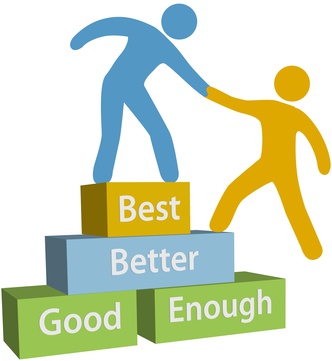 Most of the talk is about being a better manager. But what about our own contributions as employees? Seriously thinking about our work persona and making changes may also make you more indispensable. Here are some ideas for becoming a better employee.
- Show Emotional Intelligence. We live in ever-changing environments. Stress levels can be high. But the ability to manage the highs and lows at work is an increasingly important skill. If your coping mechanism keeps you from getting defensive or emotional, you probably work more effectively is tough situations. Cooperation is high among those with emotional intelligence, which makes them more valuable in the workplace.
- Plan for your own development. You may work for an organization that includes a formal development process, but if not, plan your own. The goal here is to bring out your fullest potential – you have to WANT to improve for it to happen. And when you discover what really matters to you, you’ll foster real change. Understanding what you can work on and how to improve it is important. When you actively seek out new skills, you are recognized as someone willing to take the initiative. More than likely, you’ll be given more responsibility.
- Connect. Connect. Connect. The more connections you have in the workplace, the more opportunities present themselves. Connecting with people often means admitting to what you don’t know. As you connect with more people, you can learn exponentially. Be patient. Give people a chance to get to know you, and trust you. And give as much as you can.
- Say Thank You. The most innovative managers are those who recognize the work of others. Why? Because they encourage innovation and productivity. Recognition doesn’t have to be expensive, or hard. It may mean giving a spot award to someone who has made a concerted effort to launch an initiative. If a team deserves recognition, consider something that may not be the norm for your workplace – wearing blue jeans for one week, for example. You can also consider recognizing anniversaries – perhaps a lunch outing or an unexpected coffee and bagel.
- Plan your goals, and strive to implement them. Work with your manager to plan your goals. And then make sure you review these goals daily. Try printing them out and posting them at your desk. Being proactive about progress and challenges will make you a better employee.
- Manage your time more constructively. Think about the day’s activities. What usually pulls you away from your important work? Whatever it is, minimize the time you spend on that activity. If it’s email, try checking your email just twice a day. If it’s finding files, develop a system that’s easier to remember.
- Make things easier for your boss. The idea here is to be more concise. Can you send emails that get to the point quicker? Leave out all the details that are unimportant and get to the point immediately. Can you give regular updates on a project rather than wait to be asked? Be honest. Your manager will trust you more. Ask questions. If you admit what you don’t know, you are more likely to build respect. And in many cases, your manager can point you to someone who may have the answer.
- Deal with conflict proactively. The cardinal rule is to first find out what’s causing the conflict. It may just be a stressful time in the workplace. Or it could be an overload of emotions. Talk it out. Suggest a compromise. See our tips in the next article.
You probably have ideas of your own on how you can be a better employee. This may in fact, be a good discussion to have with your manager. Be open to new ideas. You manager will come away realizing that you are on the job to be more productive. You benefit. Your organization benefits. It’s a win-win.
Follow me on Facebook, Twitter and LinkedIn this month. I’ll provide more information on how to be a better employee! Share your ideas with me!
Keys to Dealing with Conflict
-
 Sound business practices. Don’t assume. Instead, define acceptable behavior. Having clearly defined job descriptions help. Effective communication from leadership goes a long way to avoiding conflicts.
 - Don’t shrink. Some people go to great lengths to avoid conflict. What usually happens in such cases is that conflict grows. At the first suggestion, seek out potential areas of conflict and resolve them. The time you spend identifying potential projects will help you avoid future conflict.
- Identify motivations. If you can approach the problem from the prospective of what’s the best action needed to help everyone reach their objectives, you should find few obstacles
- How important is it? While it’s best to meet conflict head-on, there are some conflicts that are not important. If you call attention to the problem, you may just be blowing it out of proportion.
- Conflict is really an opportunity. There is some learning possibility that comes from any conflict. Take advantage of that opportunity and build in the potential for growth and development. Opposite positions can stimulate innovation and learning. Take advantage of it.

Ditch Bad Habits This Year
 Can 2017 be the year that you get rid of bad habits and make real strides forward? It can, but it requires new thinking. Moving forward means we have to drop some of the things we hold onto, even though they may be things we’ve come to expect, and accept. I’m one of the worst at letting go! I know it. The people around me know it. But sometimes, it seems that I just HAVE to keep those old habits going. Not this year. I’m going to make a concerted effort to let go of these bad habits. Do you want to join me? They say that if we join forces, there’s a better chance we’ll succeed in ditching our bad habits. Here’s a list of bad habits often seen in the workplace.
Striving for perfection. While we all want our work to be correct, striving for the perfect result does not pay off. We lose time, the project takes longer to complete and the end result is not significantly improved. Instead, we overstress ourselves and those around us.
Addiction to our phones. Have you noticed sometimes when you’re out, that everyone’s on their phones? Whether they’re playing games, on social media or checking email, it’s a habit most of us need to break. There’s a difference between responsible communication and not interacting with the people around you.
Accepting a high level of stress. I blame this one on the “east-coast-culture.” Truthfully though, it’s prevalent everywhere. There is so much going on in our lives that it’s easy to accept a high level of stress as normal. We sometimes contribute to our own stress. Even before we begin work, our thinking turns negative. We say to ourselves, “I’ll never get this all done today!” It’s up to us to break our own stress habit. We can turn our attitude around by saying “Let’s see how much I can get done on this project today.”
Sticking with the way we’ve always done things. There are so many tasks that can be done faster and more efficiently today than in the past. These tasks may require learning new technology – which can be frightening to many. But spending time to sit down with someone who can explain a faster way of accomplishing a tasks broadens our minds and keeps us current.
Acting too quickly. When I can’t answer emails quickly, I notice that some problems solve themselves. The same thing happens in meetings. When we listen to the discussion for a while, rather than come to a quick decision, the best way to solve the problem surfaces naturally. Holding back, rather than jumping in too quickly, is often more effective.
Follow me on Facebook, Twitter and LinkedIn this month. I’ll provide more information on bad habits we should kick and how to succeed! Share your ideas with me!
Steps You Can Take To Break Bad Habits
 Looking at the list of bad habits commonly found in the workplace, I’m pretty determined that I’d like to break myself of at least some of them. To be successful, the experts say to follow these steps.
- Find a partner who will work with you to help ditch these bad habits.
2. Put a voice to your bad habit. Admitting your habit to someone makes you accountable. Sharing your habit with a friend will also make you more conscious of it when you fall back into the habit.
3. Write it down. Whatever your bad habit, when you find yourself repeating it, write it down. Write down how you feel – what’s going through your head. This action will also make you more aware of your bad habit before it happens.
4. Think of a good response for the next time. If your bad habit is accepting too much stress, try a one-minute meditation. Or get up from you chair and take a 5-minute walk. Find something that can replace your bad habit.
5. Reward yourself. Start small. How can you reward yourself when you’ve avoided the habit? Then keep rewarding yourself and plan for a big reward when you finally feel like you’ve ditched the habit for good.
Follow me on Facebook, Twitter and LinkedIn this month. I’ll provide more information on bad habits we should kick and how to succeed! Share your ideas with me!
Positivity
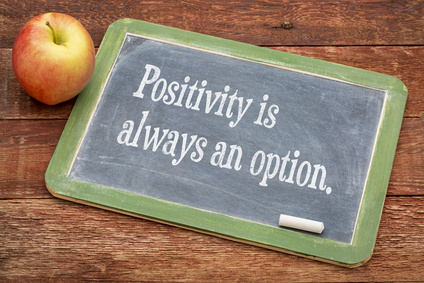 Did you happen to notice around the end of 2016 how many people were looking forward to saying goodbye to the year? 2016 was a rough one for many folks. It was a divisive political environment, we said goodbye to many sports and entertainment personalities and there were too many tragedies broadcast over the air waves.
But turning the calendar page from one year to the next does little to change our overall emotional well-being. There are lots of things we can all do to improve our mood and general outlook. I like this article from Fast Company on 10 Science-Backed Ways to Be More Positive in 2017. There are some simple ideas here, such as breathing deeply, scheduling our own self-care sessions, volunteering time and meditation. Everyone can practice some of these methods to help improve your outlook.
For me, part of being positive comes from recognizing the things that I should be grateful for. A gentle reminder to ourselves makes us realize our good fortune. Things that I’ve stressed about become less annoying when I remember how lucky I am.
I also search out positive people. Have you ever noticed how much better you feel after you’ve been around a person who inspires you? A happy, positive person generally spreads happy thoughts around the office.
Even when you adopt a few habits to increase your positivity, there are times in our lives, especially in today’s uber-connected world, when things can overwhelm us. When that happens, it may be time to change the way we live and work. We are constantly connected with our work, our home and our national and global news sources. It’s easy to feel bogged down. Maintaining positivity might mean disconnecting with the world around is – even if it’s only for a short time.
Try opening your email just twice a day. Constantly communicating with co-workers may not be the ideal situation. Think about putting your phone down when you get home in the evening, and try not to look at it until after dinner. Short breaks from the constant clutter that comes our way can be quite effective in relieving our stress and shifting our outlook from gloomy to glad!
And one more tip. So often, we measure our value by productivity. But when we try to battle three things at once, we can end up even more frustrated. Instead, focus on getting one thing done at a time. As you arrive at work each day, say to yourself – “What is the most important thing for me to do today?” Make that one action your priority and get it done. Even if it’s the ONLY thing you accomplish that day, you can positively remember that you did accomplish your most important task. And then put the rest aside, there’s another day to tackle the next project on your list!
Six Things You Can Do To Be More Positive
 These tips won’t cost you a dime. And they’re easy, so time is no excuse!
- Purposefully Breathe. Long breaths in, long breaths out. Repeat them 5 times.
- Turn off your phone. Maybe just for an hour. Watch how much you get done!
- Reward yourself. A hot bath, a walk at lunchtime, music while you cook dinner, 10 pages of your favorite book – all of these ideas will bring a calmness to your life.
- Choose a word every day that lightens the mood and brings soothing thoughts. Beach. Snow. Faith. Peace. Whatever the word is, take time during your day to consciously think about it for a minute or two.
- Get up, walk around, roll your shoulders. The simple act of pushing yourself away from your desk and computer will relax you and make you think differently.
- Thank someone. At home or at work, giving a sincere thanks to someone not only lightens that person’s day, but yours also.