Tip: The Secret to SMART Goals
Most goals aren’t SMART – not because they are hard to write, but because most people don’t ask enough questions. Follow these steps to create clear and specific goals!
- Write your goal. Then ask: Is this goal as detailed as you can make it?
- Define how you will measure your progress. Do the steps you’ve created set a clear path from where you are today to where you want to be?
- In order for a goal to be achievable, there should be periodic checkpoints leading up to the goal. What milestones can you expect to reach to ensure that the goal you set stays on track?
- Make sure that you have the tools you need to accomplish your goal. Is training needed? Does your employee have time to do the necessary work? What will you do if individuals don’t respond?
- Set a date to reach your goal – one that is reasonable and within reach. Do you have updates scheduled during that time period? It’s more likely that the goal will be accomplished if there are intermediate activities that must be met.
When goals are achieved in the workplace there’s a feeling of control and fulfillment. Employees are more likely to feel empowered and more satisfied in their work. If you need help setting SMART goals to achieve standards mandated throughout your organization, please give us a call at 301-670-0051. Let’s discuss your needs.
Telework – What Happens?
 What happens when employees telework? Since telework has become an important organizational change, not only in the Federal Government but also in the private sector, it’s important for all organizations to envision the success of the effort and measure the results. In a recent report, “Status of Telework in the Federal Government – Report to Congress,” the US office of Personnel Management noted an improvement in employee attitude as a result of telework capabilities.
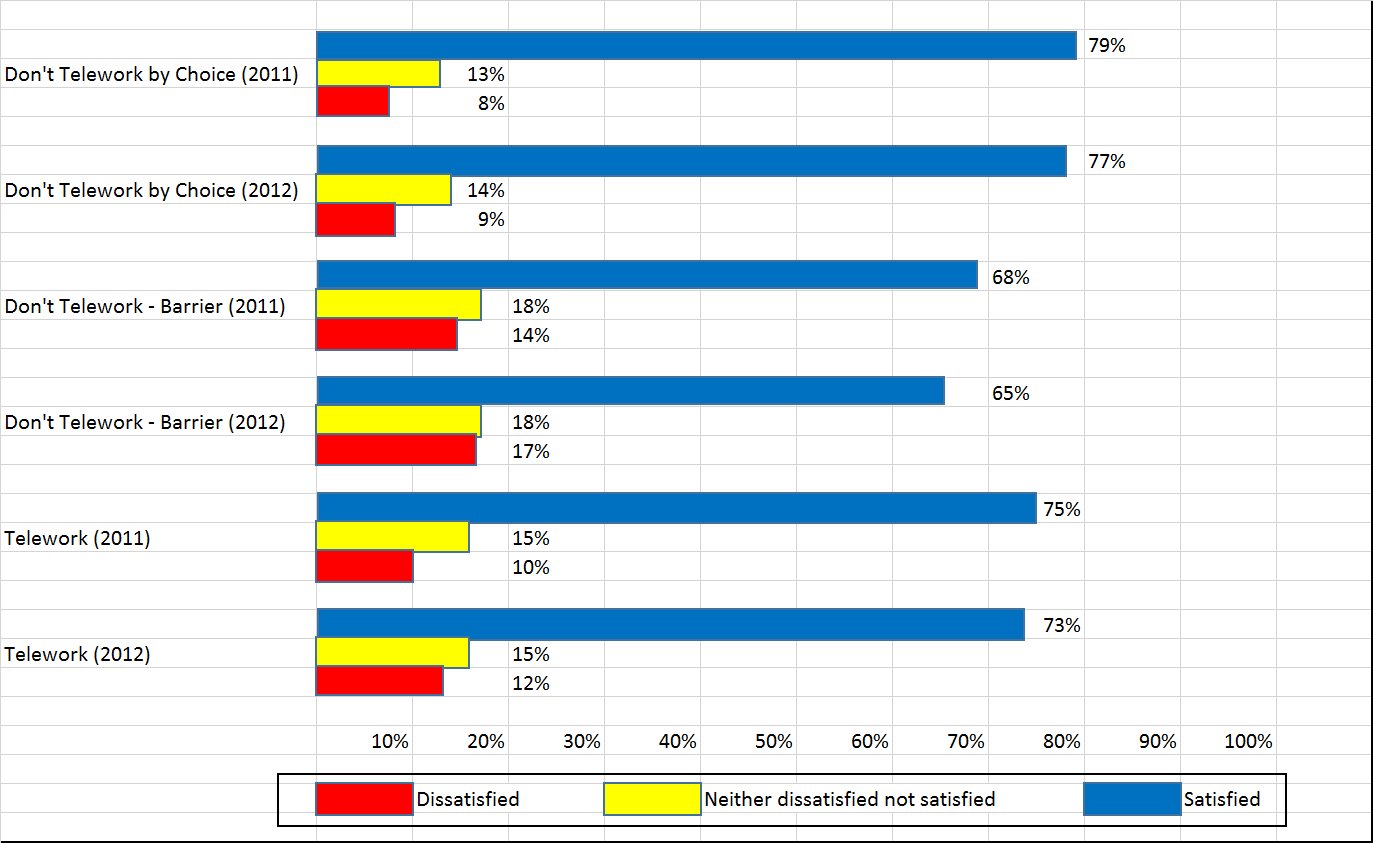
Measuring the Improvement in Employee Attitude. The Federal Employment Viewpoint Survey (FEVS) shows the potential for telework to influence important employee attitudinal and perceptual variables. The survey looked at employees who telework, those who don’t because of a barrier of some sort, and those who do not telework by choice. Demonstrated in the report is the value of autonomy – “I get to make the decision, to telework or not.” When employees have a choice, job satisfaction increases. Those employees who face barriers to telework reported lower job satisfaction scores. Typically, their attitudes toward the organization and their supervisors are less positive.
Academic research indicates that telework program participants are more likely to exhibit job satisfaction and improved performance. The FEVS survey noted similar findings. There was a larger percentage of teleworkers who reported satisfaction with their jobs than those who were not able to telework. In 2011, those figures were 75% vs 68%, and in 2012 the figures were 73% vs 65%. The survey seems to suggest that existence of telework policies benefits the entire workforce in indirect but positive ways.
In the 2012 FEVS survey, 68% of the respondents reported satisfaction with their jobs. And 15% reported dissatisfaction. The results also show that there is a decline in the percentage of job satisfied employees between 2012 (68% ) and 2011 (71%). This general decline is also reflected in a comparison of teleworker job satisfaction data – reporting 68% job satisfaction in 2011 and 65% in 2012.
Please click on the chart below for more information on job satisfaction.
Successful Teleworking Tips
Successful Teleworking
 In order for Teleworking to be successful, there should be a plan. When there is, it’s obvious that the agency wants it to work. Certainly, they don’t want telework to negatively impact careers. We uncovered a few tips for successful teleworking.
- Keep your work relationships intact. Touch base with your team members often. Reschedule your commuting days as needed. Get feedback weekly from your supervisor. And make sure he/she knows your career goals.
- Keep your career on track. Make the important meetings, even if it means changing your schedule. Be flexible. And review your emails – be sure they are tactful and diplomatic. Update your status often and take credit when it’s appropriate. Be clear about your career goals.
- Set rules. It’s easy to be too available at home. It’s up to you to set work hours, when and how you can be interrupted and what areas are off-limits. And while you’re setting rules, make a schedule and stick to it. When you telework, it’s easy to slack off without thinking, or you can become a workaholic. Neither option is good. Balancing your work and home life, as much as you can, will make you happier and more productive. And your telework plan will be successful.
In a report to the Congress on the status of telework in the Federal Government, efforts to promote telework were reported. READ MORE on the effectiveness of agency-wide telework efforts.
Teleworking: Report To Congress
In a report to the Congress on the status of telework in the Federal Government, efforts to promote telework were reported. As a rule, agencies are tasked with promoting telework efforts. Each agency has the opportunity to select from a list of efforts, as well as to detail the specific nature of these efforts. You can see below that emphasizing telework as a part of COOP is the most commonly selected option. Many agencies also made use of agency-wide techniques such as emails and meeting to advocate for telework. See below for more information.

| Agency Management Efforts to Promote Telework in 2011 and 2012** | ||
| In what ways has your agency’s management promoted your telework program | No. of agencies in 2011 | No. of agencies in 2012 |
| Aligns telework with agency strategic goals and mission | 35 | 41 |
| Advocates telework in agency-wide meetings (e.g., all-hands meetings) | 45 | 46 |
| Uses telework goal-setting and measurement hold managers accountable | 12 | 15 |
| Emphasizes telework as part of COOP (Continuity of Operations Plan) events | 66 | 68 |
| Conducts special telework events (e.g., telework awareness weeks, telework drills) | 26 | 32 |
| Transmits agency-wide emails of support | 40 | 43 |
| Develops signs/posters | 13 | 16 |
| Other | 25 | 32 |
| Our agency has not taken action to specifically promote telework in the past year | 10 | 9 |
** This information was taken from the United States Office of Personnel Management Report on the “Status of Telework in the Federal Government.”