Tip: Making Incremental Changes

Steps to the sunThe healthcare.gov site successfully deployed by making incremental changes, testing the changes and making improvements. Can this process of incremental change work at your organization? Here are some thoughts that might lead to success.



  1. Making incremental changes is not as disruptive and typically does not significantly threaten existing structures.
  2. Incremental changes are typically slower, but can move a team steadily forward. Incremental gains prove better than none at all.
  3. Often, the magnitude of a change will dictate how employees react. Employees will often react positively to a change that does not cause them to move too far from what they know.
  4. Incremental change is often determined by the gap between the current state and where you want to end up. If the gap is large, incremental changes may not be possible. But incremental changes require less change management – you’re asking your employees to make a smaller leap from what they know, to what they are comfortable with.

Change and change management can be taught. LMJA works with organizational challenges. If you need help or would like to discuss your options, give us a call at 301-670-0051, or email me at Leadership@lmja.com.

The Work Habits of Millennials

Team young professionals having casual discussionThe world we live in is automated. Technology continues to develop at a rapid pace. Companies often outsource needs. And inflation continues to rise. Compared to the world many of us grew up in, our environment today seems anything but stable. To thrive in present circumstances, workers must be flexible and adaptable. Indeed, millennials may be uniquely suited to thrive in the modern workplace.

How is it that millennials are at ease in this economy? Their work habits are different than earlier generations. Here’s how.

  • Millennials expect to balance work and life. They have no intention on working for one company during their lifetime. In fact, they expect to be mobile. Working from home, a coffee house, the gym – it all works for them. In fact, they believe they are more effective working from home.
  • And work hours? Definitely not normal! Working late into the night outside the normal business hours is just fine for millennials. They actually feel more productive!
  • Moving on to the next opportunity is also their mantra. Most millennials don’t expect to be at their present job for more than three years. And many of them plan to work on their own in the very near future.
  • This is the generation of free-lancers and entrepreneurs. Many millennials hope to turn their hobby into some kind of money-making venture. At the very least, they expect to supplement their income with some kind of business of their own.
  • Millennials like to telework – and they are good at it! In fact, most millennials EXPECT to telework.
  • The lines between personal and professional are blurring with this generation. Think about it. Smartphones make work a constant. Social media is used for both professional and casual posts. And research is done almost entirely through the internet!

If the millennials in your organization prefer video meetings, have a “side” job of some sort, prefer apartments to houses and believe office attendance is unnecessary – there’s a reason. Millennials grew up in a changing environment and are completely comfortable in one. Check out our tips for ideas on working with Millennials.

If you would like more information on training millennials and giving them the skills they need to become leaders, please give LMJA & Associates a call at 301-670-0051 or email us at Leah@LMJA.com. 

Tips for Engaging Millennials in the Workplace

  1. It’s a one-on-one relationship. If you want to work with millennials in an effective manner, get to know them! Where are they coming from and what do they want to do with their lives? What do they need to get there? Then help mentor or coach them to that goal.
  2. Provide training. It once was a given in our workforce, that we trained mid-level managers for the job. Diversity training, Communication skills, Team-building, Leadership skills – these are all training programs that were part of our workforce. They seemed to have disappeared over the last decade. And right when we need them the most! Equip your millennials with the skills they need to be leaders.
  3. Adopt frequent performance management reviews. You’ve heard the comments about how millennials were always given rewards – even when they weren’t on winning teams! Perhaps there’s some truth to that, because indeed, millennials like and need on-going performance management – not just a once-a-year review. Find a way to provide frequent feedback to the millennials in your workforce.

Shrinking Space

photodune-3951848-office-working-space-xsThe OMB, Office of Management and Budget, is putting federal office space and excess property into a deeper freeze. Announced Wednesday, April 1, OMB is requiring civilian agencies and the Defense Department to create a plan for reducing their footprint over the next 5 years. David Mader, the OMB controller announced two mandates: Set a target for reduction in square footage and adopt space design standards for any future development.

One Tactic. Reducing the total real property footprint will most likely result in more expanded teleworking for agencies and the DOD. If agencies cannot lease or buy new space, they must consolidate. The reduction plan has already had positive results since it was announced in 2013. This five year plan will likely shrink the overall footprint even more.

Successful Teleworking. So how do agencies heed this call for a smaller footprint? Achieving a successful telework program will certainly help. And according to the Report to the Congress on the 2013 Status of Telework in the Federal Government, most successful telework programs have been achieved through organizational change. When agencies actively work toward change management, goal setting becomes an essential practice. Goals that are SMART, that is, Specific, Measurable, Achievable, Relevant and Time-bound, help provide the motivation to facilitate progress. So an agency that is serious about promoting a change in work toward teleworking can gauge its success and effectiveness of the program by setting SMART goals.

Measuring Success. What goals can your agency use to measure its success? Here are some examples.

  • Increase the eligibility for telework positions
  • Set a number (percentage) of the employees that you expect to telework consistently in the coming year
  • Set a number (percentage) of the employees that you expect to telework during certain situations in the coming year
  • Develop and monitor a survey quarterly to measure the effectiveness of teleworking
  • Measure the cost savings of telework
  • Add a telework performance goal to employee reviews
  • Identify Best Practices of telework employees and publish

Proof of Success. Over the next five years, as OMB requires agencies to reduce their footprint. Assessing your goals and results will be key. Developing clear goals, and meeting them, is possible with the right focus.

Need Help? Leah M. Joppy & Associates can help your agency identify needs and solutions. Then we’ll put together the right program for you – and get results! Give us a call at (301) 670-0051 to discuss an approach that will work for your agency.

Tip: The Secret to SMART Goals

Most goals aren’t SMART – not because they are hard to write, but because most people don’t ask enough questions. Follow these steps to create clear and specific goals!

  1. Write your goal. Then ask: Is this goal as detailed as you can make it?
  2. Define how you will measure your progress. Do the steps you’ve created set a clear path from where you are today to where you want to be?
  3. In order for a goal to be achievable, there should be periodic checkpoints leading up to the goal. What milestones can you expect to reach to ensure that the goal you set stays on track?
  4. Make sure that you have the tools you need to accomplish your goal. Is training needed? Does your employee have time to do the necessary work? What will you do if individuals don’t respond?
  5. Set a date to reach your goal – one that is reasonable and within reach. Do you have updates scheduled during that time period? It’s more likely that the goal will be accomplished if there are intermediate activities that must be met.

When goals are achieved in the workplace there’s a feeling of control and fulfillment. Employees are more likely to feel empowered and more satisfied in their work. If you need help setting SMART goals to achieve standards mandated throughout your organization, please give us a call at 301-670-0051. Let’s discuss your needs.

Telework – What Happens?

Man typing at computerWhat happens when employees telework? Since telework has become an important organizational change, not only in the Federal Government but also in the private sector, it’s important for all organizations to envision the success of the effort and measure the results. In a recent report, “Status of Telework in the Federal Government – Report to Congress,” the US office of Personnel Management noted an improvement in employee attitude as a result of telework capabilities.

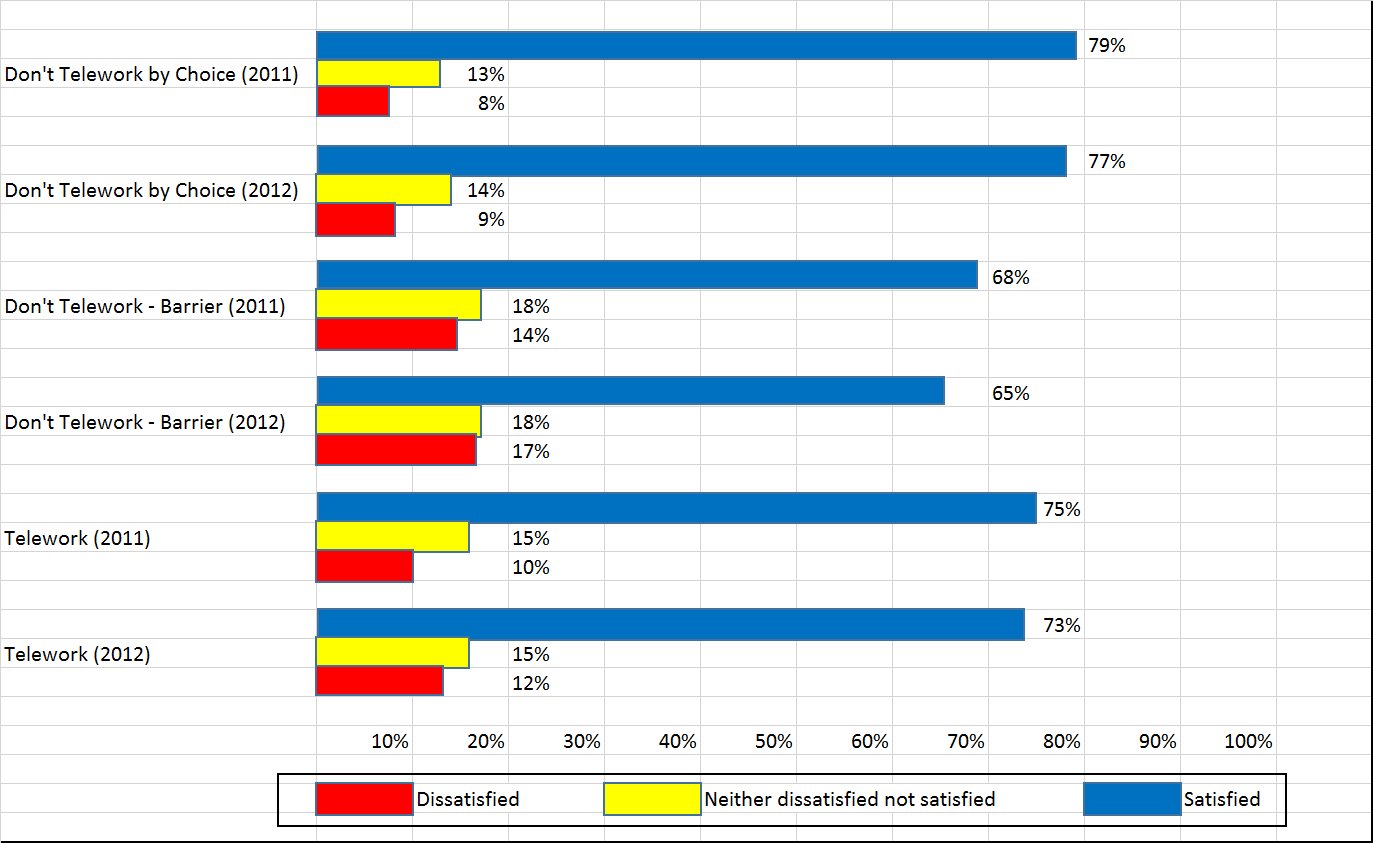
Measuring the Improvement in Employee Attitude. The Federal Employment Viewpoint Survey (FEVS) shows the potential for telework to influence important employee attitudinal and perceptual variables. The survey looked at employees who telework, those who don’t because of a barrier of some sort, and those who do not telework by choice. Demonstrated in the report is the value of autonomy – “I get to make the decision, to telework or not.” When employees have a choice, job satisfaction increases. Those employees who face barriers to telework reported lower job satisfaction scores. Typically, their attitudes toward the organization and their supervisors are less positive.

Academic research indicates that telework program participants are more likely to exhibit job satisfaction and improved performance. The FEVS survey noted similar findings. There was a larger percentage of teleworkers who reported satisfaction with their jobs than those who were not able to telework. In 2011, those figures were 75% vs 68%, and in 2012 the figures were 73% vs 65%. The survey seems to suggest that existence of telework policies benefits the entire workforce in indirect but positive ways.

In the 2012 FEVS survey, 68% of the respondents reported satisfaction with their jobs. And 15% reported dissatisfaction. The results also show that there is a decline in the percentage of job satisfied employees between 2012 (68% ) and 2011 (71%). This general decline is also reflected in a comparison of teleworker job satisfaction data – reporting 68% job satisfaction in 2011 and 65% in 2012.

Please click on the chart below for more information on job satisfaction.

Chart in Paint 61

Tip: Managing Teams

Last month we provided a few tips on successful teleworking.  Here are some key tips on Managing Teams.

  1. Train your team. While you may feel that your employees should know their job, training your employees for working on a team will help build successful teams.
  2. Keep your team focused. Putting a team together, and then not following up on their progress is asking for trouble. Instead, install a project management system or some type of follow-up plan that allows you to keep the team focused and on task. Your time will be well-spent; your team will be successful.
  3. Create a timeline. What is your vision? Working with the team, create quarterly touch points. Breaking a project down by quarters makes it easier to reach intermittent goals – assuring success for the overall project.

If you would like more information on Development issues, including Teamwork and Management, please give LMJA Associates a call at 301-670-0051 or email us at Leah@LMJA.com.

Successful Teleworking Tips

Successful Teleworking

Women Analyzing DataIn order for Teleworking to be successful, there should be a plan. When there is, it’s obvious that the agency wants it to work. Certainly, they don’t want telework to negatively impact careers. We uncovered a few tips for successful teleworking.

  1. Keep your work relationships intact. Touch base with your team members often. Reschedule your commuting days as needed. Get feedback weekly from your supervisor. And make sure he/she knows your career goals.
  2. Keep your career on track. Make the important meetings, even if it means changing your schedule. Be flexible. And review your emails – be sure they are tactful and diplomatic. Update your status often and take credit when it’s appropriate. Be clear about your career goals.
  3. Set rules. It’s easy to be too available at home. It’s up to you to set work hours, when and how you can be interrupted and what areas are off-limits. And while you’re setting rules, make a schedule and stick to it. When you telework, it’s easy to slack off without thinking, or you can become a workaholic. Neither option is good. Balancing your work and home life, as much as you can, will make you happier and more productive. And your telework plan will be successful.

In a report to the Congress on the status of telework in the Federal Government, efforts to promote telework were reported. READ MORE on the effectiveness of agency-wide telework efforts.

Teleworking: Report To Congress

In a report to the Congress on the status of telework in the Federal Government, efforts to promote telework were reported. As a rule, agencies are tasked with promoting telework efforts. Each agency has the opportunity to select from a list of efforts, as well as to detail the specific nature of these efforts. You can see below that emphasizing telework as a part of COOP is the most commonly selected option. Many agencies also made use of agency-wide techniques such as emails and meeting to advocate for telework. See below for more information.

photodune-9519624-telework-word-cloud-concept-s

Agency Management Efforts to Promote Telework in 2011 and 2012**
In what ways has your agency’s management promoted your telework program No. of agencies in 2011 No. of agencies in 2012
Aligns telework with agency strategic goals and mission 35 41
Advocates telework in agency-wide meetings (e.g., all-hands meetings) 45 46
Uses telework goal-setting and measurement hold managers accountable 12 15
Emphasizes telework as part of COOP (Continuity of Operations Plan) events 66 68
Conducts special telework events (e.g., telework awareness weeks, telework drills) 26 32
Transmits agency-wide emails of support 40 43
Develops signs/posters 13 16
Other 25 32
Our agency has not taken action to specifically promote telework in the past year 10 9

 ** This information was taken from the United States Office of Personnel Management Report on the “Status of Telework in the Federal Government.”

Can Strategic Planning Make Your Job Easier?

strategy cycle illustration designMention Strategic Planning in a meeting and you’re liable to hear lots of groans! For many companies and organizations, strategic planning involves weeks of research, competitive analysis, meetings, budgeting and planning. Besides all that work, strategic planning conjures up the idea that we have to KNOW the future. Or at least take a good guess. Good luck with that. Besides the fear of making the wrong decision, thinking too far in the future just isn’t practical anymore. Thanks to technology and the world we live in, most businesses see so much change that they are revising their strategic plans every 18 months. So, what if you just plan for the year? Make it simple. Here’s how.

First, Analyze. What has worked in the past? What has not worked? Are your employees fully trained? What areas of expertise are lacking? Decide what your strategy is for the year.

Focus on the issues at hand. What are the initiatives in your area that will have the most impact on the organization as a whole? These are the ones you want to focus on. Do your employees have the expertise to carry out the initiatives as planned? Can your area be more productive given more expertise?

Start with the end in mind. Where do you want to be by December 2015? If you know what progress needs to be made, it’s easier to schedule check points throughout the year.

Make a check list. Assuming there are goals for the department and the individual employees, make a list of what needs to be accomplished. Incorporate change management and leadership development training to transform your area to a higher performing organization.

Schedule it. Work it out on paper. What is the initiative? What results are you expecting? And what tools are needed to get there? When you break it down bit by bit, you’ll recognize whether or not your plan is feasible.

Review performance. Meet quarterly, or more often if necessary, to make sure the initiative hasn’t hit a roadblock. Don’t assume that you’ll know when that happens. Too often, organizations learn in September or October that the initiative they thought was humming along, hit a roadblock in June. Now, months have gone by without progress.

Keep it simple. You can tackle a lot, and be disappointed in your results. Or you can take the top issues and get results. Your goal is to get results, so that the next year, you can focus on other issues.

Need some help with starting or updating a strategic plan? Leadership development? Dealing with communication and conflict within teams? We can help. Give Leah M. Joppy & Associates a call at 301-670-0051 or email us at leah@lmja.com – we’d love to help.

Try our tip. Read on for an easy tip to keep you focused on your strategy and get results!